

[Accueil] “Women Human Right Defenders in the Context of Business and Human Rights: Role of Indigenous Women and leaders in the defense of land and territory”
![[Accueil] “Women Human Right Defenders in the Context of Business and Human Rights: Role of Indigenous Women and leaders in the defense of land and territory”](https://pressclub.ch/wp-content/uploads/2025/11/Image_Flyer-e1763634487551.png)
[Accueil] “Women Human Right Defenders in the Context of Business and Human Rights: Role of Indigenous Women and leaders in the defense of land and territory”
#PartnerEvent
The Geneva Press Club is pleased to host a side event organized as part of the 14th United Nations Forum on Business and Human Rights.
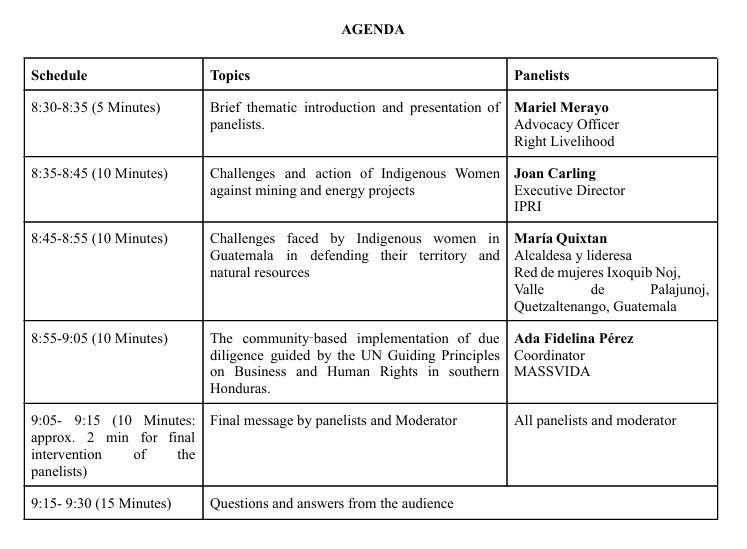
Speakers :
- Joan Carling, an Indigenous Kankanaey leader from the Cordillera region in the Philippines, is Co-founder and Executive Director of Indigenous Peoples Rights International (IPRI) and a 2024 Right Livelihood Laureate recognized for her global advocacy for Indigenous rights and climate justice.
- María Quixtan, a K’iche leader from the Valle de Palajunoj in Quetzaltenango, Guatemala, who serves on the municipal indigenous council and is active in the network “Red de mujeres Ixoquib Noj”, linking her work to the Escazú Agreement.
- Ada Fidelina Pérez Pedrano, an Honduran environmental activist and coordinator of the “Movimiento Ambientalista Social del Sur por la Vida (MASSVIDA)”, which unites 36 community organizations and focuses on defending land, water, children’s and women’s rights against agro‑industrial and mining projects.
Event organized by: Right Livelihood Award, Plataforma Internacional contra la Impunidad, IndigenousPeoples Rights International (IPRI), SERJUS Asociación Comuniataria para el Desarroll
English and Spanish interpretation available.
Background
Since its creation in 2011, the annual UN Forum on Business and Human Rights has brought together thousands of participants from governments, international organizations, indigenous peoples, business, trade unions, civil society, communities, lawyers and academia from around the world. Centred on the UN Guiding Principles on Business and Human Rights (UNGPs) – the global framework for States and businesses to prevent and address business-related impacts on human rights – the Forum has provided a unique multi-stakeholder platform for discussing trends and challenges in implementing the UNGPs and realizing a more sustainable global economy.
In countries such as Nepal, Mexico, Guatemala, Honduras, El Salvador, and Nicaragua, much of the ancestral territories are under pressure from mining, agro‑industrial plantations, and hydroelectric dams. Because women are tied to water management, family agriculture, and household care, they experience the environmental impacts directly. Their leadership in protests and in creating networks for territorial defense has brought international attention to the link between human rights, indigenous sovereignty, and ecological sustainability.
The violence against Indigenous women is often structural and multifaceted: domestic violence, femicides, forced displacement, and the criminalization of protest. By raising their voices, these women highlight the intersection of patriarchy, racism, and colonialism. Their demands—for example, seeking justice for femicide victims or the inclusion of a gender perspective in development plans—have driven legal reforms and the creation of protection mechanisms that are more attuned to their realities. Through community organizations, elders’ councils, and transnational movements, Indigenous women have managed to influence public agendas. Notable initiatives include:
- Indigenous Women’s Councils in the Maya region, which formulate proposals for sustainable development and intercultural education.
- Women’s Water Defender Networks, which have achieved the suspension of hydroelectric projects threatening vital watersheds.
- Participation in peace processes, such as in Guatemala, where the presence of Indigenous women in reconciliation dialogues has helped incorporate historic reparations and recognition of collective rights.
- Indigenous Women Defenders in the frontlines of protecting lands and resources such as thecase of Indigenous Women in the Cordillera Philippines who remain courageous in the face of criminalization and false charges against them.
The resistance of these women does not stop at their local communities; it has forged alliances with global feminist movements, human‑rights organizations, and scholars. These connections expand international pressure capacity, facilitate the exchange of strategies, and reinforce the narrative that the fight for Indigenous rights is also a fight for climate and gender justice on a planetary scale. Analyzing and sharing experiences about Indigenous and peasant women’s resistance to extractive projects and territorial defense worldwide is not merely a response to isolated threats; it is an ongoing practice of self‑definition, autonomy, and social transformation. Recognizing their central role moves societies toward greater justice, resilience, and respect for both human and natural diversity.